
The early Olympic Games were celebrated as a religious festival from 776 B.C. until 393 A.D., when the games were banned for being a pagan festival (the Olympics celebrated the Greek god Zeus). According to legend, it was Heracles who first called the Games "Olympic" and established the custom of holding them every four years. In 1894, a French educator Baron Pierre de Coubertin, proposed a revival of the ancient tradition, and thus the modern-day Olympic Summer Games were born.
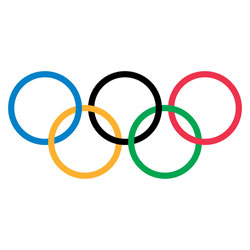 The Olympic rings
The Olympic rings, originally designed in 1912 by Baron Pierre de Coubertin,The five interconnected Olympic rings represent the five significant regions of the world – Africa, the Americas, Asia, Europe and Oceana, and every national flag in the world includes one of the five colors, which are (from left to right) blue, yellow, black, green, and red. The rings are interconnected to symbolize the friendship to be gained from these international competitions. The Olympic flag was first flown during the 1920 Olympic Games.
The Olympic Flame
The Olympic flame is a practice continued from the ancient Olympic Games, which celebrates the theft of fire from the Greek god Zeus by Prometheus. In Olympia (Greece), a fire was kept burning throughout the celebration of the ancient Olympics. The flame first re-appeared in the modern Olympics at the 1928 Olympic Games in Amsterdam. The flame itself represents a number of things, including purity and the endeavor for perfection. The Olympic Torch relay was introduced by Cal Diem at the controversial 1936 Berlin Olympics. The Olympic flame is lit at the ancient site of Olympia, by eleven women, representing the Vestal Virgins, they perform a ceremony in which the torch is kindled by the light of the Sun. The Olympic Torch is then passed from runner to runner from the ancient site of Olympia to the Olympic stadium in the hosting city. The flame is then kept alight until the Games have concluded. The Olympic Torch relay represents a continuation from the ancient Olympic Games to the modern Olympics. After being lit, the flame continues to burn throughout the Games, and is put out on the day of the closing celebration.
Real Gold Medals
The last Olympic gold medals that were made entirely out of gold were awarded in Sweden during the 1912 games.
The Medals
- The Olympic medals are designed especially for each individual Olympic Games by the host city's organizing committee. Each medal must be at least three millimeters thick and 60 millimeters in diameter. Also, the gold and silver Olympic medals must be made out of 92.5 percent silver, with the gold medal covered in six grams of gold plate.
- Silver medals were awarded for first place in the first modern Olympics. The Games hosted in Athens in 1896 awarded first place winners silver medals and second place bronze medals. Third place received nothing.
- The 1900 Games hosted in France awarded winners paintings instead of gold medals. The French believed that paintings were more valuable than medals, and thus awarded winners according to what they deserved.
- Great Britain is the only nation to have won at least one gold medal at every Summer Games.
- Larrisa Latynina, a gymnast from the former Soviet Union, finished her Summer Olympic Games career with 18 total medals, more Olympic medals than any other competitor.
The First Marathon
The event was instituted to commemoration of the fabled run of the Greek soldier Pheidippides and is one of the original modern Olympic events. In 490 BC, Pheidippides, a Greek soldier, ran from Marathon to Athens (about 25 miles) to inform the Athenians about the outcome of the Battle of Marathon (the namesake of the race). The distance was filled with hills and other obstacles; thus Pheidippides arrived in Athens exhausted and with bleeding feet. After telling the townspeople of the Greeks' success in the battle, Pheidippides fell to the ground dead. In 1896, at the first modern Olympic Games, held a race of approximately the same length in commemoration of Pheidippides.
The Exact Length of a Marathon
During the first several modern Olympics, the marathon was always an approximate distance of 26 miles. In 1908, the British royal family requested that the marathon start at the Windsor Castle so that the royal children could witness its start. The distance from the Windsor Castle to the Olympic Stadium was 42,195 meters (or 26 miles and 385 yards). In 1924, this distance of the "26 miles and 385 yards" became the standard for the marathon.
First TV Broadcast
The "Berlin Olympics" held in 1936 were the first Olympic games ever to be broadcast on television.
Cancelled Games
Because of World War I and World War II, there were no Olympic Games in 1916 (Berlin Germany), 1940 (Helsinki, Finland), or 1944 (London, England).
First Perfect 10
Romanian "Nadia Comaneci" was the first gymnast to score a perfect 10 seven times in a row. She achieved this feat in the 1976 Montreal Games. Since the scoreboards were not equipped to display scores of 10.0, Nadia's perfect marks were flashed as 1.00 instead
Oldest and Youngest Olympian
The youngest Olympian was Dimitrios Loundras of Greece, he was 10 years old and competed in the 1896 Olympics as a gymnast. The oldest Olympian was Oscar Swahn of Sweden, he was 72 years old and participated in 1920 games as a shooter. Hilda Lorna Johnstone of Great Britain is the oldest women, she was 70 years old when she participated in 1972 games. 12-year-old Inge Sorensen from Denmark won a bronze medal in the 200-meter breaststroke in 1936, making her the youngest medalist ever in an individual event.
Women
There were "no women" participants in the first modern Olympics which were held in 1896, it was felt that their inclusion would be "impractical, uninteresting, unaesthetic, and incorrect". Women were first allowed to participate in 1900 at the second modern Olympic Games in Paris, France. The 2012 Olympics is the first to have a woman from every country, but with the fact that Female Boxing has been included in the list of events, every sport now has male and female competitors.
A City, Not a Country
When choosing locations for the Olympic Games, the IOC specifically gives the honor of holding the Games to a city rather than a country. London will be the first city to host the Olympics for a 3rd time (1908, 1948 & 2012). Athens has also hosted 3 Olympic games, but one of them, the 1902 Athens Intercalated Olympic Games do not counted as an official Olympic event. Competitors where required to shoot at mannequins dressed in frock coats. There was a Bull's eye were on the dummy's throat. The event was held over 20 meters and 30 meters.
Winter Games Begun
The first ever Winter Olympic Games were held in Chamonix, France in 1924, beginning a tradition of holding them a few months earlier and in a different city than the summer Olympic Games. Beginning in 1994, the Winter Olympic Games were held two years apart from the summer Games.
Gymnasium
The word "gymnasium" comes from the Greek root "gymnos" meaning nude; the literal meaning of "gymnasium" is "school for naked exercise." Athletes in the ancient Olympic Games would participate in the nude.
- The first opening ceremonies were held during the 1908 Olympic Games in London.
- The only Olympian ever to be awarded the Nobel Peace Prize was Philip Noel-Baker of Great Britain, who won the silver in the 1500-meter dash in 1920.
- The first black athlete to compete in the modern Olympics was Constantin Henriquez de Zubiera, competing for France in 1900. The first black athlete to win a gold medal was African-American John Taylor, who was part of the US relay team in athletics in 1908. In the 1960 Rome Olympics "Abebe Bikila" of Ethopia won the marathon by registering a record time of 2hrs 15mins and 16.2 secs. He ran this marathon bare footed. He was also the first African to win an Olympic gold medal. Only one white person has ever run the 100 meters in under 10 seconds, several hundred black men have done it. In 2010, a French runner named Christophe Lemaitre ran the 100 meters in 9.98 seconds.
- More athletes than spectators attended the 1900 Paris Olympic Games.
- Pigeon shooting was one of the sports on the program during the Paris Olympics in 1900. Fortunately this shooting event was short lived. It was the only time animals were killed on purpose during an Olympic event. Dueling Pistol Shooting was and official Olympic event in 1912. Motor boating was an official sport at the 1908 Olympics. Tennis was played at the Olympics until 1924 when it was banned, then re-instituted in 1988. The tug of war was once an Olympic event and was held at the Olympics from 1900 to 1920. Tug of war was in fact part of the Ancient Olympics, first being held in in 500BC
- The Olympics were a religious event for the ancient Greeks. Ancient Olympic athletes competed nude.
- China's one of the contenders in almost every Olympic event now, but China didn't win its first medal until 1984.
- Three continents – Africa, South America, and Antarctica – have never hosted an Olympics
- As of 2008 only four athletes have ever won medals at both the Winter and Summer Olympic Games: Eddie Eagan (United States), Jacob Tullin Thams (Norway), Christa Luding-Rothenburger (East Germany), and Clara Hughes (Canada).
- Nobody has won more medals at the Winter Games than cross-country skier Bjorn Dählie of Norway, who has 12.
- In 1928, reportedly six of the eight entrants in the women's 800-meter race collapsed at the finish line in an "exhausted state." Poor training methods and the brutal Amsterdam sun were the two major causes of distress. That event was subsequently cancelled until 1960.
- Traditionally, Greece leads the parade during the opening ceremony.
- The Olympic motto - Citius, Altius, Fortius - means Faster, Higher, Stronger.
- French is the official second language of the Olympics.
- The longest Olympics lasted 187 days in London 1908. They started in April and continued on until October.
Ancient Olympic Games Facts
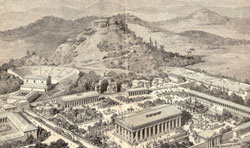 The first Olympics in 776 BC, there was only one event—a short 200 meter sprint called a stade.
- During the ancient Olympic games, which were first staged in Olympia in 776 B.C., the Greeks held a lampadedromia, or torch relay, where athletes competed by passing on a lit torch until a final runner passed the finish line. A similar ritual took place in Athens at the Panathenaia festival, held every four years in honor of the city’s patron, the goddess Athena.
- The winner received an olive wreath, there were no gold, silver, or bronze awards in the ancient Olympics.
- Thousands of people from all over Greece would come to watch the Games. The main stadium could hold about 45,000 people and thousands of tents would be set up around the stadium.
- The first 15 Olympic games, had only running as a sport, and the first 13 contained only the stadium foot race. Long distance running was not introduced until the 14th Olympics.
- In addition to running, events at the Ancient Olympics included boxing, equestrian (horseback riding), pentathlon, running, wrestling, hoplitodromos and the pankration.
- On the first day of the competition, the pentathlon was held containing five separate events: running, discus, long jump, javelin, and wrestling. These were designed to test an athlete’s all-around athleticism. The athlete who won three events was the considered the victor.
- Races in armor, or hoplitodromos, featured competitors engaged in a two stadium-length race, carrying a shield and wearing a helmet and lower leg armor
- The pankration was the old-school version of the Ultimate Fighting Championship, introduced into the Greek Olympic Games in 648BC. A combination of wrestling and boxing, pankration also included arm-twisting, biting, kicking, strangleholds, and finger-breaking. Only eye-gouging and biting were discouraged.
- Because there were usually wars occurring during the Olympics, the Greeks (talk about fair play) set aside a month’s truce so athletes and spectators from different countries could travel to the Games.
- Chariot-racing drew rich competitors, it was not the rider, but the owner of the chariot and team who was considered to be the competitor. A victory in the event was relative to natural ability, hard work, and a lot of money behind it. The event was unique because women could participate in the event as horse owners. In the 264 BC Olympic Games a woman Bilistiche is mentioned as a winning as a chariot owner.
- Married women were prohibited from watching the Games under penalty of death!
- All male athletes competed naked!
- Unlike other Olympians who rubbed their bodies with olive oil, wrestlers were supposed to only dust themselves with powder. Some cheated by rubbing an oily hand over their body to make it too slippery for their opponent to hold.
- Statues of Zeus lined the athletes’ path to the stadium at Olympia, which were all paid for by hefty fines levied by the Greeks against cheating athletes. They were so serious about the Games that one athlete who backed out of the competition was fined for cowardice.
- The Ancient Olympics lasted until 393 AD when the Roman Emporer Theodosius I—a convert to Christianity—couldn't tolerate the paganism of the Games.
The 10 Greatest Ancient Olympians
1. Leonidas of Rhodes (stadion, diaulos, hoplitodromos): 12 victories in four festivals from 164 B.C. to 152 B.C.
2. Herodoros of Megara (competition for heralds): 10 victories in ten festivals from 328 B.C. to 292 B.C.
3. Hermogenes of Xanthos (stadion, diaulos, hoplitodromos): 8? victories in three festivals from 81 to 89 A.D. (the Olympic Register is somewhat unclear).
4. Astylos of Kroton (stadion, diaulos, hoplitodromos): 7 victories in three festivals from 488 B.C. to 480 B.C.
5. Hipposthenes of Sparta (boys’ wrestling, wrestling): 6 victories in six festivals from 632 B.C. to 608 B.C.
6. Milo of Kroton (boys’ wrestling, wrestling): 6 victories in six festivals from 536 B.C. to 516 B.C.
7. Chionis of Sparta (stadion, diaulos): 6 victories in three festivals from 664 B.C. to 656 B.C.
8. Nero of Rome (competition for heralds, tragedy, lyre, tethrippon, foals tethrippon, 10-horse chariot): 6 victories in one festival in 67 A.D. (these games were later declared illegitimate).
9. Gorgos of Elis (diaulos, hoplitodromos, pentathlon): 6 victories in four festivals (dates unknown).
10. Aelius Granianus of Sikyon (diaulos, hoplitodromos, pentathlon): 5 victories in four festivals from 133 to 145 A.D.
Sources:
http://en.wikipedia.org/wiki/Nadia_Com%C4%83neci
http://en.wikipedia.org/wiki/Ancient_Olympic_Games
http://www.rdasia.com/21-olympic-facts
http://www.olympic.org/olympic-torch-relay-facts-and-figures
http://www.olympic.org/olympic-torch-relay-origin-values-ceremony
http://www.historyonthenet.com/Olympics/olympicfactsfiguresdragndrop.htm
http://www.neatorama.com/2008/08/02/10-fascinating-facts-about-the-ancient-olympic-games/
http://en.wikipedia.org/wiki/Olympic_Games