Weird Facts & More 23
WeirdFacts · The Curiosity CollectionNo. 23 / 25 Stories
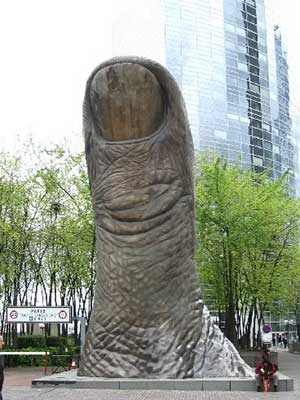
Paris has a 12-metre thumb
A sculptor’s actual thumb, Darwin’s attempt at riding a giant tortoise, and a planet where one spin takes longer than a year.
Oversized objects & odd rules
A thumb as tall as a building, two very different penny stories, and a 400,000-year-old campsite.
A sculptor turned his own thumb into a 12-metre monument
The French artist César Baldaccini made a 40-centimetre model of his thumb in 1965. He later scaled it up for La Défense, the business district just west of Paris. That version, installed in 1994, stands 12 metres tall and weighs 18 tonnes. If you’ve ever wanted to see a thumbprint from across a plaza, this is your chance.
Source: Paris La Défense: César’s Le Pouce and the original model
A “rule of thumb” was a rough estimate as far back as the 1600s
In a sermon published in 1685, Scottish minister James Durham compared people to builders who worked “by guess, and by rule of thumb” rather than using proper tools. Measuring roughly with a thumb is a plausible explanation for the expression, but its exact origin isn’t known.
Sources: University of Michigan Library: the digitized 1685 edition of Durham’s sermons · Grammarphobia: what the evidence says about the phrase’s origin
The letters “GP” on a wartime Ford didn’t stand for “general purpose”
In Ford’s wartime model code GPW, G meant government, P identified the vehicle’s 80-inch wheelbase, and W referred to the Willys design it was based on. Where the nickname “jeep” came from is less certain. The tidy “general purpose” explanation doesn’t match Ford’s own model code.
Sources: Lyon Air Museum: the Ford GPW and the meaning of its model code · The Henry Ford: the companies behind the wartime jeep
The United States has a travel rule just for pennies and nickels
U.S. regulations make a point of counting pennies and nickels together. The ordinary exception for travellers leaving the country lets them carry up to US$5 in those two coins combined. There’s a separate allowance of up to US$25 for legitimate personal collecting or recreation. So no, five dollars isn’t an absolute limit.
Source: Electronic Code of Federal Regulations: exceptions for one- and five-cent coins
The final U.S. circulation pennies were auctioned with gold pennies
The United States struck its last pennies for circulation in November 2025. The Mint auctioned 232 special sets, each pairing two of the last circulation pennies with a 24-karat gold penny made for collectors. The sale marked the end of producing pennies for everyday use, not the end of the pennies already in your jar.
Sources: United States Mint: penny history and the three-coin auction sets · Reuters: the final 2025 strike and what happened to existing pennies
A 400,000-year-old site holds evidence that early humans made fire
Researchers reported in 2025 that a site near Barnham, England, contained a patch of heated clay, heat-shattered flint handaxes and two pieces of iron pyrite. The mineral is rare near Barnham, so finding it beside the burned patch was a clue that someone made the fire rather than just using a natural one. That pushes the known evidence for fire-making back by about 350,000 years.
Source: Natural History Museum: the Barnham discovery and how it was dated
Odd human habits, on and off camera
Darwin tries a terrible form of transport, Harry Potter repeats an outfit, and a movie shark ends up in a junkyard.
Charles Darwin tried riding giant tortoises
On the Galápagos Islands, Darwin wrote that he sometimes climbed onto giant tortoises and tried to stay aboard as they walked off. “I found it very difficult to keep my balance,” he admitted. Slow and steady is not the same as a smooth ride.
Source: Darwin Online: his account in the Galápagos chapter of the Beagle journal
Mary Shelley kept a relic believed to be her husband’s heart
After the poet Percy Bysshe Shelley drowned in 1822, a friend said he recovered his heart from the funeral pyre. According to a later account, Mary kept the relic wrapped in silk, and her son found it with a page from Percy’s poem Adonais. Whether the remains were really his heart is disputed. The keepsake is strange enough without settling the anatomy.
Sources: Snopes: what the evidence says about the Shelley relic · The Conversation: the Shelley story in the context of Romantic-era keepsakes
Daniel Radcliffe wore the same jacket and hat to spoil paparazzi photos
While appearing in the London play Equus in 2007, Radcliffe said he wore the same hat and zipped-up jacket when leaving the theatre for six months. The shirt underneath changed. From the photographers’ side of the zipper, every night looked like the same old shot.
Source: CBS News and Associated Press: Radcliffe explains his trick
Economists have looked at underwear sales for clues about a recession
In 2009, The Washington Post reported on the idea that men put off replacing worn-out underwear when money is tight. The reasoning was that you can make do with a tired pair of briefs without anyone at the office noticing. It’s a quirky clue, not a reliable forecast hiding in the laundry basket.
Sources: NPR Planet Money: the reasoning behind the underwear indicator · The Denver Post: a reprint of the 2009 Washington Post report
Read More: The original Washington Post story
A man who is legally blind rode alone in a car with no steering wheel
In 2015, Steve Mahan rode through an Austin, Texas, neighbourhood in Google’s Firefly prototype. This time there was no test driver, no steering wheel and no pedals. Mahan had tried an earlier self-driving prototype in 2012, but that ride still had a trained driver alongside him.
Sources: Waymo: Steve Mahan’s two rides and what changed between them · Waymo: the Firefly prototype and its lack of manual controls
A shark made from the Jaws mould spent years in a junkyard
The sharks used to film Jaws didn’t survive. A later shark made from the original mould did, and an NPR reporter helped track it down at a California junkyard. It was restored and displayed at the Academy Museum, which opened a 50th-anniversary Jaws exhibition in 2025. Not bad for a shark that never actually made it into the movie.
Sources: NPR via Indiana Public Media: how the shark was tracked down · Smithsonian magazine: the Jaws anniversary exhibition
Strange little lives
A sponge that pulls itself together, flowers with a flair for faces, and a lot of spiders under one roof.
Separated sponge cells can come back together
In a lab demonstration, a sea sponge was separated into individual cells. A time-lapse shows those cells gathering and forming small new sponges. Once separated, a sponge’s cells can do something most of us struggle with after a long weekend: pull themselves together.
Source: Shape of Life: the time-lapse of sponge cells recombining
An orchid got its name from a natural pottery glue
The puttyroot orchid grows from rounded underground stems called corms. They contain a sticky substance that was once used to mend broken pottery. The corms often grow in pairs, which explains its other nickname: the Adam and Eve orchid.
Source: Missouri Department of Conservation: the two names and how the plant grows
The monkey-face orchid is real, and its name starts with Dracula
The flower of Dracula simia can look uncannily like a little monkey’s face. The species is native to southeastern Ecuador, where it grows on other plants. “Monkey flower” can mean other plants, so look for Dracula simia if you want the one with the face.
Sources: Royal Botanic Gardens, Kew: the accepted name and native range · BBC Wildlife: unusual orchids, including the monkey-face orchid
Take a look: See a photo of Dracula simia
A Peruvian flower was named after a cartoon fire demon
Described in 2025, the shrub Aphelandra calciferi has orange-red and yellow blooms that look like little flames. Its name honours Calcifer, the fire demon in Hayao Miyazaki’s Howl’s Moving Castle. It’s a real plant with a name straight out of an animated film.
Source: Royal Botanic Gardens, Kew: the fire-demon flower and its name
Two kinds of spider share a cave web bigger than 100 square metres
Researchers studying Sulfur Cave on the Albania–Greece border found a vast sheet of connected webs. In 2025, they estimated that more than 110,000 spiders of two species lived there. It’s less one spider’s masterwork than an entire apartment block with very thin walls.
Sources: Subterranean Biology: the study of the Sulfur Cave spider colony · Phys.org: photos and the size of the colony
A newly described pumpkin toadlet can be smaller than a fingernail
Scientists described Brachycephalus lulai from the cloud forests of southern Brazil in 2025. The bright orange males measured as little as 8.9 millimetres long. Despite the name, it’s a tiny frog, not something you’d put in a pie.
Sources: PLOS One: the species description and measurements · Phys.org: photos and the discovery in Brazil’s cloud forests
Brains, fossils & planets that fool the eye
A tiny brain with 50 million connections, a famous face that wasn’t, and a very long eclipse.
An early bird fossil revealed feathers that filled a gap in its wing
In 2025, scientists studying the Field Museum’s Archaeopteryx reported long feathers on its upper arm. The feathers filled the gap between the body and the rest of the wing, which would have helped form a continuous surface for flight. The same fossil preserved even tinier details: under ultraviolet light, researchers could see scales on the bottoms of its toes.
Source: Field Museum: what UV light and CT scans revealed in the fossil
Your brain uses about a fifth of your oxygen at rest
The adult brain accounts for roughly 2% of body weight but uses about 20% of the body’s oxygen. That’s not the same as getting 20% of the blood pumped by the heart, which is closer to 15%. Even sitting still and staring into the fridge, your brain is doing a lot of work.
Source: NCBI Bookshelf: brain physiology, oxygen use and blood flow
A fruit fly brain has about 50 million connections
Researchers mapped 139,255 neurons in an adult fruit fly brain and about 50 million connections between them. The map, published in 2024, lets scientists follow how cells are wired together. If you’ve ever missed a fruit fly with a swatter, it may help to know the other side brought this much wiring.
Source: Princeton University: the fruit fly brain map and its counts
Five minutes of structured breathing a day helped lift mood in a study
In a 2023 randomized study, people who practised brief breathing exercises daily reported better moods. One technique, called cyclic sighing, put the emphasis on longer exhales and reduced breathing rate. The study was about mood and stress, not whether you can replace a bike ride by breathing more dramatically.
Source: Stanford Health Care: the published study abstract
Read More: Stanford Medicine’s explanation of the study
Venus takes longer to spin once than to go around the Sun
Venus takes about 243 Earth days to rotate once relative to the stars, but only 225 Earth days to orbit the Sun. That’s the sense in which its day is longer than its year. From one sunrise to the next, though, it’s about 117 Earth days, because Venus spins in the opposite direction from most planets.
Source: NASA: Venus’s slow rotation, short year and sunrise interval
The famous “Face on Mars” lost its face in better photos
A 1976 Viking image showed a Martian landform that looked uncannily like a face. A sharper view from Mars Global Surveyor in 2001 showed an ordinary eroded hill. Change the light and increase the detail, and Mars stops looking like it’s staring back.
Sources: NASA Jet Propulsion Laboratory: the sharp 2001 image and the original Viking view · European Space Agency: Cydonia and the surrounding terrain
Four astronauts saw the Moon eclipse the Sun for nearly 54 minutes
During the April 2026 Artemis II flyby, the Moon passed between the spacecraft and the Sun, completely blocking the Sun for nearly 54 minutes from the crew’s perspective. They photographed a glowing halo around the Moon’s dark edge. Down here on Earth, even the longest total solar eclipse lasts less than eight minutes.
Sources: NASA: the Artemis II eclipse photograph and the duration of totality · Live Science: how long total solar eclipses on Earth can last
- Last updated on .
- Hits: 19439