Weird Facts & More 7
WeirdFacts · The Curiosity CollectionNo. 07 / 25 Stories
The fortune cookie got five numbers right
Fortune-cookie numbers won second prize in Powerball, Russia taxed beards, and penguin poop may help make clouds. It’s a strange world. Here are the receipts.
Objects with stories
A lottery tip you can eat, a bottle with very late mail, and a roomful of artificial snow.
Fortune-cookie numbers helped produce 110 Powerball second-prize winners
In March 2005, 110 Powerball players matched the five white-ball numbers in a single draw. Lottery officials suspected fraud until winners around the country told them they’d used numbers from fortune cookies made by Wonton Food. The cookies said 40 for the final number. It was 42. So much for being able to see the whole future.
Source: NBC News and the Associated Press: the lottery investigation
Two soldiers’ messages in a bottle turned up 109 years later
In 1916, Australian soldiers Malcolm Neville and William Harley wrote notes aboard a troopship and sent them off in a bottle. A family found it on a Western Australian beach in 2025. Neville had asked the finder to pass his note to his mother. Harley was less particular: the finder could keep his.
Source: CNN and the Associated Press: the bottle and both letters
A boomerang carved from a mammoth tusk may be 40,000 years old
A 2025 study dated bones found near a crescent-shaped artefact in a Polish cave. The results suggest the ivory boomerang is about 39,000 to 42,000 years old. It probably wasn’t designed to return when thrown. Considering how long it stuck around anyway, that seems like a minor complaint.
Source: Smithsonian Magazine: the new dating and how it was done
A battered sixpence may have left the mint looking that way
A 2026 study examined a badly deformed British silver coin from 1834. The faces are heavily damaged, but much of the grooved edge is still intact. The author concluded the pattern was consistent with a manufacturing mishap. It may have had a rough day before it ever made it into somebody’s pocket.
One snow globe as a gift led to a collection of 11,000
Josef Kardinal began collecting snow globes after receiving one in 1984. Guinness reported in 2025 that he’d amassed about 11,000 in Nuremberg, Germany. He even showed how he refills them to keep them looking their best. At that point it’s less a display shelf than a forecast.
Plastic can disappear from sight without going away
A plastic container doesn’t have a universal expiry date in the ocean. Sunlight, temperature and the type of plastic all affect what happens. NOAA says many plastics don’t break down completely; they fragment into tiny pieces called microplastics. Smaller isn’t the same as gone.
Wild Earth & beyond
Lightning by the second, vowel-like whale clicks, and a trip a little farther than the Moon.
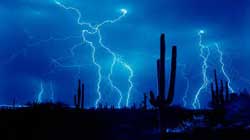
Earth averages about 44 lightning flashes a second
Researchers used a satellite instrument to estimate about 1.4 billion lightning flashes a year worldwide. That includes flashes within clouds as well as those that reach the ground. The planet really is that busy. The weather at your window just isn’t a representative sample.
Source: NASA Technical Reports Server: the satellite lightning count
A zoo chimp collected stones before the visitors arrived
Santino, a chimpanzee at Sweden’s Furuvik Zoo, calmly gathered stones and stashed them before the gates opened. Later, in a very different mood, he threw stones towards visitors. Researcher Mathias Osvath took the contrast as evidence of planning ahead. The zoo hadn’t even opened, and Santino was already thinking about the public.
Sources: Lund University: the study on planning ahead · CBC News: how researchers observed Santino
This Brazilian island is the only wild home of the golden lancehead
The venomous golden lancehead lives in the wild on Ilha da Queimada Grande, off Brazil’s coast. Having an entire species confined to one small island sounds like a horror-film setup, but it’s a conservation problem. The snake is critically endangered, and there’s no second island population to fall back on.
Sources: Field study: the island’s golden lanceheads · Annals of the Brazilian Academy of Sciences: the species and its habitat
Penguin poop may help make Antarctic clouds
In a 2025 study, researchers measured much more ammonia in the air when the wind blew from an Adélie penguin colony. Ammonia from the guano can help form tiny airborne particles that water vapour can condense on. That doesn’t tell us how cloudy Antarctica would be without penguins, but it does add a new item to their job description.
Source: Chemical & Engineering News: the Antarctic guano study
Researchers found vowel-like patterns in sperm whale clicks
Sperm whales produce short sequences of clicks called codas. In 2025, researchers reported two distinct sound patterns with acoustic properties resembling human vowels, plus some that shift between sounds. Nobody knows what those patterns mean. The whales aren’t speaking English, and we’re not ready to offer subtitles.
Three newly described Tanzanian toads give birth to tiny toads
Researchers described three new tree-toad species from Tanzania’s Eastern Arc Mountains in 2025. Rather than laying eggs that hatch into free-swimming tadpoles, these toads give birth to fully formed toadlets. For these nursery graduates, the swimming lessons are optional.
Sources: Vertebrate Zoology: the three tree-toad species · Phys.org: why live-bearing toads are unusual
In 2026, four people flew farther from Earth than the Apollo 13 crew
On April 6, 2026, the Artemis II crew passed Apollo 13’s distance record during a flight around the Moon. Canadian astronaut Jeremy Hansen flew with Reid Wiseman, Victor Glover and Christina Koch. They reached 252,756 miles from Earth, about 407,000 kilometres. The previous record had stood since 1970.
Sources: NASA: Artemis II passes the Apollo 13 record · NASA: the final distance and mission recap
Body oddities
Feet hoard bones, fingernails win the slow race, and one case of hiccups lasted nearly seven decades.
About a quarter of your bones are in your feet
Each foot has 26 bones. Add the two feet together and you get 52 out of the standard adult count of 206. For something you can stuff into a pair of shoes, that’s an impressive share of the skeleton.
Sources: Cleveland Clinic: the skeletal system and foot bones · Cleveland Clinic: 26 bones in each foot
Charles Osborne hiccupped for 68 years
It wasn’t a long afternoon that felt like 68 years. Guinness records the Iowa man’s hiccups as lasting from 1922 to 1990. He learned to breathe between hiccups to muffle the sound. For most of us, a hiccup is an interruption. For Osborne it was practically the punctuation.
Fingernails can grow about twice as fast as toenails
A small study of 22 healthy young adults found that fingernails grew an average of 3.47 millimetres a month and toenails 1.62. The little fingernail was the slowpoke among fingers, while the big toenail led among toes. Neither result makes a nail-growth race a good spectator sport.
Source: Journal of the European Academy of Dermatology and Venereology: measured growth rates
The clear front of your eye has no blood vessels
A healthy cornea stays transparent in part because no blood vessels cross it. It gets oxygen and nutrients by diffusion, including oxygen from the tear film on its surface. A blink does a lot more than mark your disagreement.
Source: StatPearls via the National Library of Medicine: cornea anatomy
Rules, rides & real history
A tax on beards, a highway without ordinary car traffic, and a dispute about what grounded a Disney boat.
Peter the Great taxed beards and issued tokens as receipts
Peter the Great pushed Russians towards Western European fashions, and keeping a beard could mean paying a tax. The British Museum has a copper beard-tax token from 1705, stamped with a beard and moustache. If you were going to pay for the privilege, at least the receipt looked the part.
Mackinac Island started banning cars in 1898
The Michigan village banned cars in 1898, and the state park that covers most of the island followed in 1901. There have been exceptions. Cars came in for the 1979 filming of Somewhere in Time, but the crew could drive them only during filming. On Mackinac, even a movie star’s car can be told to stay put.
Source: Mackinac Island Tourism: the original ban and its exceptions
French Foreign Legion recruits start under a different name
The French Foreign Legion says recruits must change their name when they join. They can return to their legal identity through a formal process after at least six months, once they provide the required documents. It’s an administrative rule, not a licence to erase your past.
Disneyland’s “Small World” boats got stuck in a very small world
The Los Angeles Times reported a dispute in 2007 over why boats were getting stuck on the Disneyland ride. A theme-park writer blamed heavier loads; Disney blamed layers of fibreglass from years of patching the channel. What Disney confirmed was a planned ten-month closure to replace the flumes. Apparently even a small world needs major plumbing.
Source: Los Angeles Times: the stuck boats and Disney’s response
Georgia students organised an integrated prom in 2013
At Wilcox County High School, families and students had long organised separate private proms along racial lines. In 2013, students held a dance open to everyone. The district then announced the school would host its first official prom in 2014, open to all students.
Source: CNN: the student-organised prom and the school’s response
A Soviet pilot returned to flying after losing both lower legs
Aleksei Maresyev was shot down over German-occupied territory in 1942. He spent 18 days making his way to safety. After both legs were amputated below the knee, he learned to fly with prostheses and returned to active duty. His story inspired Boris Polevoi’s novel The Tale of a Real Man.
Source: Los Angeles Times and the Associated Press: Maresyev’s obituary
A missed US$75 fee left a Tennessee home without fire protection
In 2010, firefighters from South Fulton, Tennessee, did not put out a fire at Gene Cranick’s home outside city limits because his household hadn’t paid the city’s annual fire-service fee. The crew responded when the blaze threatened a neighbouring property that had paid. Cranick said he offered to pay on the spot, but the mayor said that wasn’t allowed.
Sources: NBC News: the fire and the city’s subscription policy · ABC News: the family and the neighbouring property
Venice’s “haunted island” has a stranger story than the ghost version
Poveglia was used to isolate plague patients in the early 1800s. It later housed a sanatorium for elderly long-term patients, which closed in 1968. In 2025, a local association took on management of part of the island. The quarantine and hospital are documented. The ghosts haven’t supplied paperwork.
Sources: Visit Venice: the island’s documented history · Poveglia per Tutti: the community project
- Last updated on .
- Hits: 59116